
The economics of content distribution have shifted permanently. A decade ago, launching your own branded streaming application required a development team, a significant capital investment, months of build time and an ongoing technical infrastructure that only well-funded organisations could sustain. In 2026 that calculation has changed completely. White-label streaming technology has matured to the point where launching a fully branded streaming application is a business decision, not an engineering project – and the organisations that understand this are moving faster than their competitors.
Whether you are a content creator with an existing audience, a broadcaster looking to extend your reach, a sports organisation wanting direct relationships with your fans or an entrepreneur building a new streaming business from the ground up, the pathway to a branded streaming app has never been more accessible or more strategically important.
Why Branded Streaming Apps Matter More in 2026 Than Ever Before
The streaming market has matured significantly but it has not consolidated in the way many predicted. Instead of a handful of dominant platforms absorbing all viewership, the opposite has occurred – audiences have demonstrated a clear willingness to pay for multiple specialised services that serve specific interests better than any general platform can.
This is the central opportunity for branded streaming apps. A general streaming platform competes with Netflix, Disney+, Amazon Prime and a dozen other well-funded services for the same broad audience. A branded streaming app focused on a specific content category, community or interest serves an audience that the general platforms have underserved or ignored entirely.
Sports organisations, faith communities, regional broadcasters, educational content creators, music channels, gaming content networks and niche entertainment providers have all discovered that their audiences are willing to pay a direct subscription to access content that genuinely serves their specific interest. The branded app is the infrastructure that enables that direct relationship.
Owning your distribution channel changes the business model fundamentally. When your content lives on someone else’s platform, they own the audience data, they control the discovery algorithms and they take a significant revenue share. When your content lives on your own branded app, you own the subscriber relationship, the viewing data and the full subscription revenue.
What a Branded Streaming App Actually Requires
Understanding the components of a functional branded streaming app clarifies why the white-label approach has become the dominant model for organisations entering the streaming market.
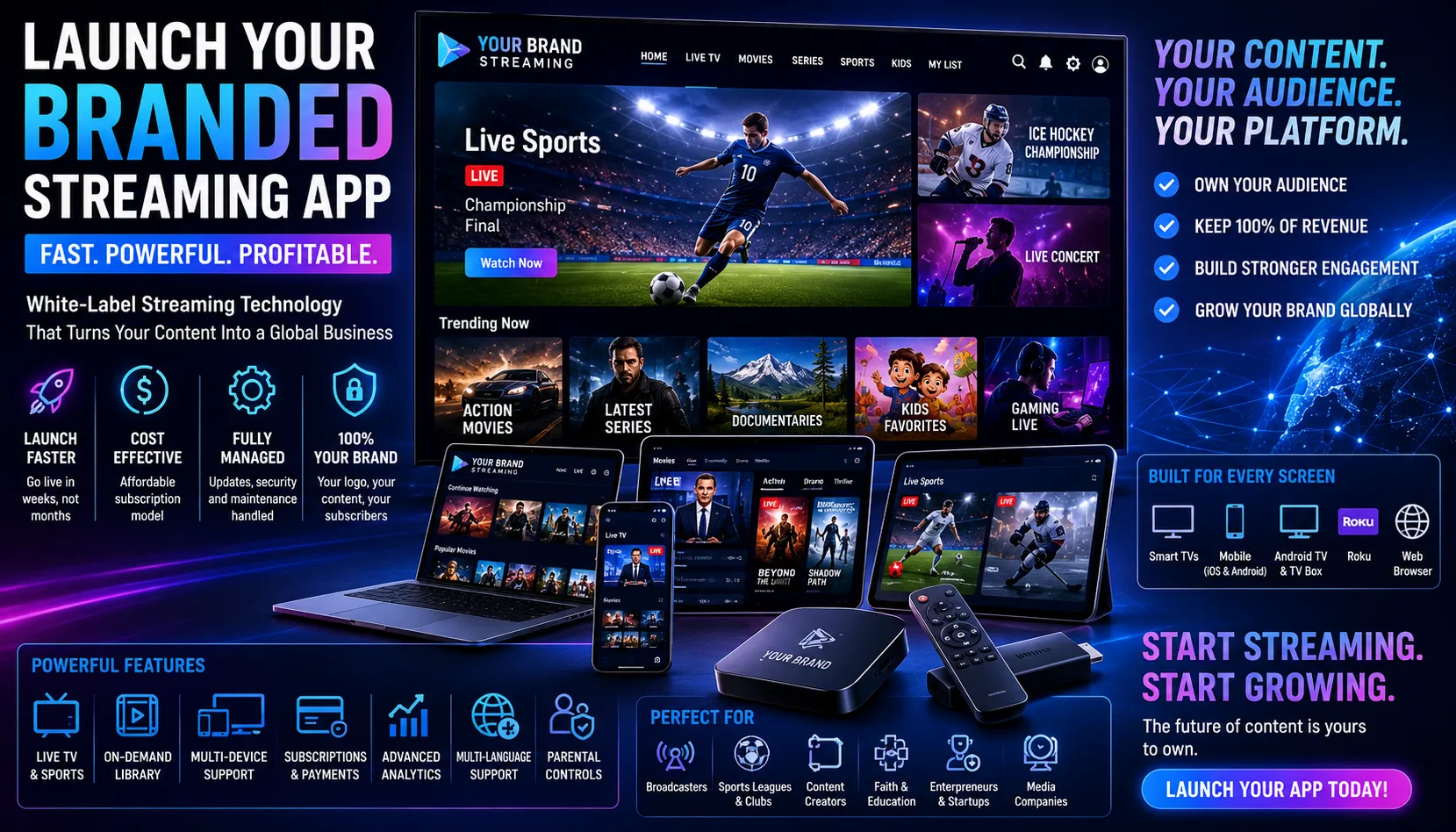
The front-end application is what your subscribers see and interact with. It needs to exist as a Smart TV app compatible with Samsung Tizen, LG webOS, Android TV and Roku, as a mobile app for iOS and Android, and as a web-based interface for desktop viewing. Building these natively across every platform represents months of development work and ongoing maintenance as operating systems and device capabilities evolve.
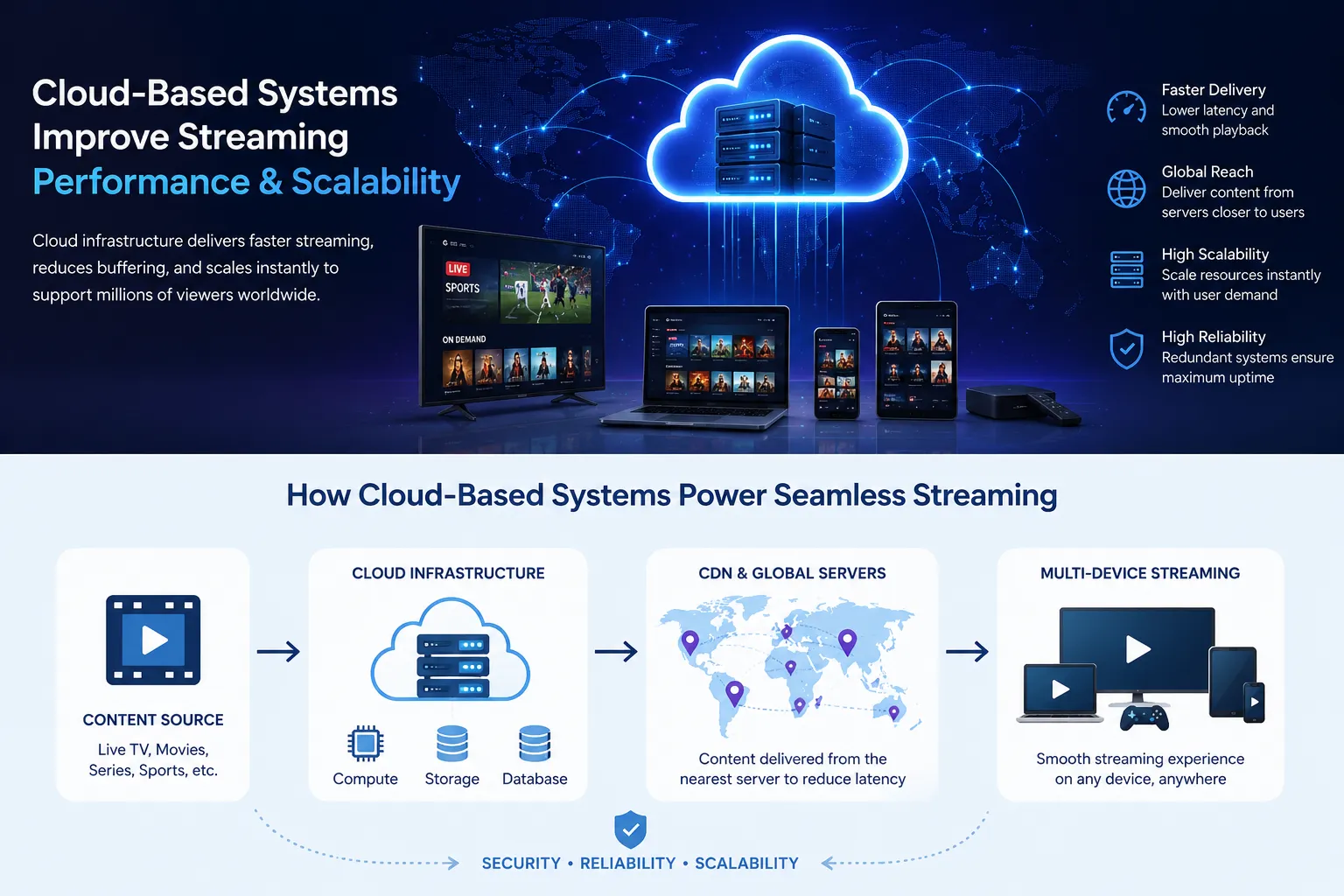
The streaming infrastructure handles the actual delivery of video content from your servers to your subscribers’ screens. This includes the content delivery network that minimises latency and ensures geographic coverage, the adaptive bitrate encoding that adjusts video quality to match each viewer’s connection speed and the server capacity that scales automatically when viewership spikes during live events.
The content management system allows you to upload, organise, schedule and manage your content library without requiring technical expertise for each action. A well-designed CMS is the operational backbone of a streaming service and the difference between a platform you can manage independently and one that requires constant developer involvement.
The subscriber management and payment system handles subscriptions, billing, cancellations, free trials and account management. Integration with payment processors, support for multiple currencies and the ability to create tiered subscription models are all part of this layer.
Analytics and reporting give you the data you need to understand your audience – which content they watch, for how long, on which devices, at which times and from which geographies. This data is the foundation of every content and business decision you make as a streaming service operator.
Building all of these components from scratch is a project of significant scope and cost. White-label streaming technology provides them as an integrated package, allowing you to focus on content and audience rather than infrastructure.
The White-Label Advantage – Speed, Cost and Control
White-label streaming technology has reached a maturity in 2026 where the question is no longer whether it can deliver a professional result but how quickly you can move from decision to launch.
Time to market is the most dramatic difference between building and using a white-label solution. A custom-built branded streaming app across all platforms typically requires six to twelve months of development before the first subscriber can log in. A white-label solution can be configured, branded and launched in a fraction of that time – weeks rather than months in many cases.
Cost structure changes from capital expenditure to operational expenditure. Building a custom solution requires significant upfront investment before any revenue is generated. White-label solutions operate on a subscription or revenue-share model that aligns costs with the growth of the business. You pay for what you use rather than for what you might eventually need.
Ongoing maintenance and updates are handled by the white-label provider rather than your own team. When Apple releases a new iOS version, when Samsung updates its Smart TV operating system or when streaming protocols evolve, the white-label platform updates to remain compatible. This is engineering work that would otherwise require permanent technical staff.
Feature development benefits from a shared customer base. A white-label provider serving hundreds of streaming operators has the resources and the incentive to build features that individual operators could never justify developing independently. Advanced analytics, recommendation algorithms, multi-language support, accessibility features and parental controls are all examples of capabilities that come included in a mature white-label platform.
Who Should Launch a Branded Streaming App
The organisations and individuals for whom a branded streaming app creates genuine strategic value span a wider range than most people initially assume.
Sports organisations and rights holders are among the most natural candidates. A football club with a passionate fanbase, a martial arts promotion with a global audience or a motorsport series looking to monetise archive content and live events directly all have the same fundamental need – a direct channel to their audience that they control completely.
Regional and niche broadcasters are discovering that the economics of streaming make direct-to-consumer distribution more attractive than distribution through aggregators and cable operators who take significant margin and provide limited data about the viewers themselves.
Content creators and media personalities with established audiences have discovered that the platforms that built their audience are not reliable long-term business partners. Algorithm changes, policy shifts and revenue-share adjustments have made the case for owned distribution infrastructure more compelling with every year that passes.
Faith organisations and communities represent one of the largest and most underserved markets in streaming. Congregation members who live far from their home community, international viewers who want access to services in their language and organisations with significant archive content libraries all have clear needs that a branded app addresses directly.
Educational content providers can use branded streaming infrastructure to deliver courses, lectures and educational programming in a format that mirrors the streaming experience their students already use for entertainment, with the subscription and content management tools that an educational business requires.
Corporate communications and training teams within larger organisations use white-label streaming to deliver internal video content, training programmes and company broadcasts in a professional, controlled environment that consumer platforms do not provide.
The Revenue Models Available to Streaming App Operators
One of the significant advantages of owning your own branded streaming application is the flexibility to choose revenue models that match your content and audience rather than accepting the model imposed by a third-party platform.
Subscription video on demand (SVOD) is the Netflix model – a recurring monthly or annual fee that grants access to the full content library. It provides predictable recurring revenue, incentivises content investment and creates the highest subscriber lifetime value when churn is managed effectively.
Transactional video on demand (TVOD) charges per piece of content – a rental or purchase model that works well for premium live events, new release films or one-off access to specific content. A pay-per-view boxing match or a premium sports event can generate significant revenue without requiring a full subscription commitment from viewers.
Advertising-supported video on demand (AVOD) offers content free to viewers in exchange for advertising inventory. This model works best for content with broad appeal and high viewership volume, where advertising rates justify the foregone subscription revenue.
Hybrid models combine subscription access with pay-per-view premiums for specific content. A subscription that covers regular programming with additional pay-per-view access for exclusive live events is a structure that many sports and entertainment streaming services have adopted successfully.
B2B licensing allows you to offer your content to other platforms and operators in addition to your direct consumer offering. Having your own streaming infrastructure makes this licensing relationship more straightforward to execute and more profitable to structure.
Technical Considerations That Actually Matter
Most organisations launching a streaming app do not need to understand every technical detail of the infrastructure they are using. But a few considerations are worth understanding at a strategic level.
Content delivery network geography determines where your service performs well and where it struggles. A CDN optimised for European delivery will not serve Asian audiences at the same quality. If your content has international appeal, confirm that your white-label provider’s CDN coverage matches your target markets.
DRM and content protection is non-negotiable for licensed content. Digital Rights Management ensures that content cannot be downloaded and redistributed outside your platform. Any serious white-label streaming provider supports the major DRM systems – Widevine for Android and Chrome, FairPlay for Apple devices and PlayReady for Microsoft platforms.
Live streaming capability is a separate technical requirement from on-demand content delivery and one that not every white-label platform handles equally well. If live broadcasting is part of your content offering, verify specifically that the platform supports live streaming with the latency and stability your use case requires.
Scalability during peak demand is the technical test that matters most for live content. A platform that handles a hundred concurrent viewers easily but degrades at ten thousand is not adequate for live events. Ask specifically about concurrent viewer capacity and how the platform scales automatically when viewership spikes.
API availability determines how well the streaming platform integrates with your existing systems – your website, your CRM, your email marketing platform and your analytics tools. A well-documented API that allows data flow between systems is a significant operational advantage over a closed system that requires manual data export.
With purplesmart.app you get a white-label streaming platform built for organisations ready to launch their own branded streaming app. The infrastructure, the multi-platform app delivery, the subscriber management tools and the content management system are all provided as an integrated solution, allowing you to focus on content strategy and audience growth rather than engineering challenges.
The Launch Process – From Decision to Live Service
Understanding the typical launch sequence helps organisations plan realistically and avoid the delays that commonly affect streaming launches.
Brand and design configuration is the first phase – applying your visual identity, colour palette, logo and interface design to the white-label template. For organisations with existing brand guidelines, this is typically a fast process. For those developing their streaming brand fresh, it is worth investing time in getting the visual identity right before launch rather than changing it shortly after.
Content preparation and upload runs in parallel with brand configuration. Content needs to be encoded in the correct formats for streaming delivery, organised into the library structure that subscribers will navigate and associated with any metadata – descriptions, thumbnails, categories and access permissions – that the CMS requires.
Platform submission and approval is the phase that most organisations underestimate. Submitting an app to the Apple App Store, the Google Play Store and the Samsung Smart TV app store each involves a review process that can take anywhere from a few days to several weeks. Plan for this in your launch timeline and submit early.
Subscriber acquisition preparation should be underway before launch, not after. Your existing email list, social media audience and any direct marketing capabilities you have should be ready to activate on launch day. A streaming platform with no subscribers is a sunk cost, and the first thirty to sixty days of subscriber acquisition set the trajectory for the business.
Testing across all target devices is non-negotiable before launch. Stream your content on every device and platform you plan to support, under different network conditions, and identify any issues before they affect paying subscribers. A bad first experience is significantly harder to recover from than a delayed launch date.
Measuring Success After Launch
Launching the app is the beginning of the work, not the end of it. The metrics that matter for a streaming business are specific and worth understanding before you have data to measure.
Monthly active users tells you how many of your subscribers are actually using the service each month. A high subscriber count with low active users indicates a product problem that will eventually manifest as high churn.
Average viewing time per session indicates how engaging your content is relative to your subscribers’ expectations. Short sessions that do not complete content are a signal to investigate.
Churn rate – the percentage of subscribers who cancel each month – is the metric that ultimately determines whether a subscription streaming business is sustainable. Industry benchmarks vary by content category but understanding your churn rate and its trend is more important than the absolute number.
Device distribution tells you where your subscribers are actually watching, which should inform your development and optimisation priorities.
Content performance data showing which titles, live events or channels drive the most viewing time tells you where to focus your content investment going forward.
Frequently Asked Questions
With a white-label platform, most organisations can go from signed agreement to live service in four to eight weeks.
No, white-label platforms are designed to be managed by non-technical operators through intuitive content management interfaces.
A full-featured white-label platform supports Smart TV, iOS, Android, web browsers and streaming sticks like Chromecast and Fire TV.
White-label platforms integrate with payment processors to handle subscription billing, renewals and cancellations automatically.
Yes, free trial periods are a standard configurable feature in mature white-label streaming platforms.
With your own branded platform, subscriber data belongs to you rather than to a third-party platform operator.
The Window Is Open
The conditions that make branded streaming apps viable for organisations of every size exist right now. The technology is mature, the cost structure is accessible, the audience behaviour is established and the competitive advantage of owning your distribution channel is clear.
The organisations that launch their own streaming apps in 2026 will spend the next several years building direct subscriber relationships, accumulating audience data and developing content strategies informed by real viewing behaviour. The organisations that wait will spend those same years paying an increasing percentage of their content revenue to platforms they do not control and audiences they cannot reach directly.
The infrastructure exists. The audience is ready. The decision is yours.